How the Lead Sheet Became a Working Song Format
The lead sheet’s history explains how melody, lyrics and chord symbols became a portable way to share songs while leaving room for performers to shape them.
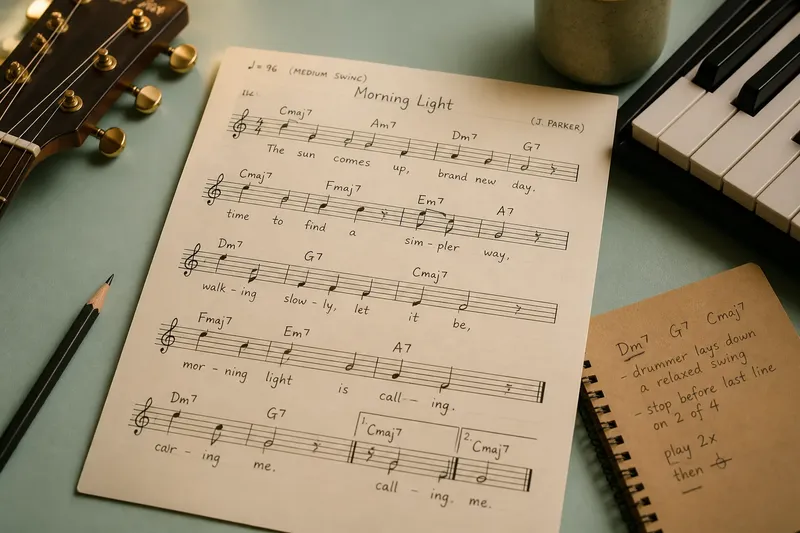
How did a page with a melody and chord symbols become a practical way to share a song? The lead sheet’s history is best understood through the different ways musicians have written down tunes without fixing every detail of their performance.
Songs before lead sheets
Before printed notation was widely available to a particular musician, a tune could be passed on by singing, playing and listening. Such transmission did not require a standard document: the learner could absorb the melody and adapt it through performance.
Written music offered another means of preserving and sharing songs. A score could record many parts in detail, while a page with only lyrics or a melody carried less information. These forms served different purposes; one did not simply replace the other.
It is difficult to describe a single origin for the lead sheet without making the history sound neater than it is. Song documents varied by place, publisher and use. A melody with lyrics, a piano accompaniment, a handwritten chord sequence and a tune learned by ear could all help a song travel, but they did not amount to one uniform format.
Printed songs and practical notation
Printed song music could give a singer a melody and words, and might include piano accompaniment. That offered a household performer more guidance than lyrics alone, while still leaving room for choices about how to accompany the tune.
As music-making took place in different settings, a fully specified arrangement was not always the most useful document. A compact page could instead foreground the melody and harmony, letting performers adapt the song to their instruments and ensemble. This describes a practical contrast between kinds of notation, not a claim that one format appeared everywhere at a particular moment.
The lead sheet belongs to this family of working documents. Its history is less a straight line from memory to print than a continuing negotiation: what needs to be written so another musician can recognise and support a song, and what can be left to performance?
The changing page
A typical lead sheet sets a notated melody above lyrics, with chord symbols placed near the points where the harmony changes. It may also name the key, time signature, tempo, title and writer. The exact contents vary, so the label does not imply that every sheet has identical features.
Chord symbols are concise instructions for harmony. A symbol such as C indicates a C major chord; additions such as minor or seventh specify a different quality. The symbol usually does not prescribe a voicing—the arrangement of chord tones across an instrument’s range—so a pianist and guitarist can play the same harmony in different ways.
That economy is part of the format’s appeal, but it also reflects a trade-off. A lead sheet can communicate a tune and its harmonic framework without recording every instrumental line. If an arrangement depends on exact entries, counter-melodies or coordinated rhythmic figures, a fuller score or separate parts may be needed instead.
What the format leaves open
A lead sheet generally does not specify a complete bass line, drum pattern, instrumental counter-melody or vocal harmony. It also leaves room for choices in tempo, groove, voicing and phrasing. The written melody gives performers a shared reference, but it does not capture every expressive detail of a singer’s delivery.
Say a songwriter brings a page to rehearsal with a melody, lyrics and chord symbols, but no drum part. The guitarist can establish the harmony, the singer can shape the phrasing, and the drummer can suggest a pulse; if the group then agrees on a stop before the final line, a brief cue can be added to the page. The result is a shared version that records the decision needed for coordination without specifying every sound.
The balance between fixed information and open choices helps explain why the lead sheet remains useful in settings where musicians need to make a song playable together. Its history is not simply the story of a document becoming shorter; it is also the story of performers and writers deciding which details matter to preserve.
When does the shorthand need help?
Why might a chord symbol be unclear?
A symbol may leave the intended bass note or chord colour uncertain. If the bass note matters, use a slash chord; if a particular quality must remain audible, add a concise note.
Why can the melody seem to clash with a chord?
A sustained or passing melody note may not be apparent from a bare chord symbol. Check the melody where the harmony changes, then clarify the symbol or mark the deliberate exception.
Why do musicians produce different versions?
They may interpret open directions differently, especially around rhythm, repeats or the ending. Add only the cue needed to coordinate them, such as a repeat sign, a stop cue or a groove note.
When is a fuller score more suitable?
Use a fuller score or separate parts when the arrangement depends on exact ensemble entries, written counter-lines or tightly coordinated changes. The lead sheet can still identify the song, but it does not show each player everything that must be played precisely.
Keep the record focused
A crowded page can make the melody and harmony harder to read. Include details that identify the song or help musicians stay together; leave optional colour choices for rehearsal when they do not affect the song’s identity.
It is not worth spelling out a standard chord voicing for every instrument if players can choose suitable shapes themselves. The exception is a particular sound or bass movement that is part of the song rather than a decorative preference.
- Check whether the melody is legible; if it is, keep the notation, but if it is not, rewrite or space the notes before sharing.
- Check whether each chord symbol sits at the intended change; if it does, retain its position, but if it does not, move it to the correct moment.
- Check whether the lyrics align clearly with their notes; if they do, leave them, but if not, adjust the spacing or syllable placement.
- Check whether the key is named when players need it to begin; if it is, keep the marking, but if it is absent and the key is known, add it.
- Check whether repeats and the ending are unambiguous; if they are, keep the directions, but if not, add a repeat sign, ending mark or clear cue.
- Check whether a bass note or chord colour is essential; if it is, specify it with a slash chord or concise note, but if not, leave the voicing open.
The history of the lead sheet makes its central compromise clear: preserve enough for another musician to recognise and support the song, and use a fuller score when the arrangement requires more exact instructions.