A Rainy Afternoon, One Album, and a Listening Map
A one-album listening map helps you notice an opening, a shift in mood and a final track without pausing the music or turning listening into homework.
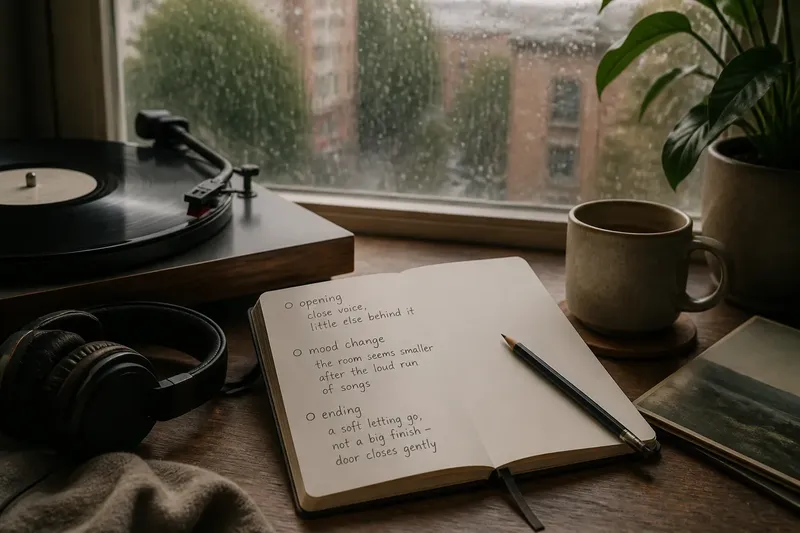
How do you listen closely to an album without turning every song into a puzzle? A one-album listening map gives your attention three gentle stopping points—the opening, a change of mood and the final track—while the music keeps moving. On a rainy afternoon, you can let the record play and jot down only what stays with you.
The map is not a review, a ranking or a hunt for hidden meanings. It is a small record of how the album’s shape reaches you in one sitting. You might notice an instrument entering, a voice becoming more exposed or a closing song that leaves the room feeling different. Those observations can be plain and uncertain; the point is to notice, not to solve.
A map, not a score
Albums ask for a different kind of attention from a playlist assembled around a mood. A playlist may be designed to keep one feeling steady, while an album can arrange contrast: a sparse song beside a crowded one, a brisk opening followed by a patient passage, or a familiar sound returning in a changed setting. A listening map helps you register that movement without deciding in advance what it means.
Think of it as three pencilled marks on a route. The opening establishes a first impression; a mood change shows the route bending; the final track gives you a place to pause and look back. You need not map every stop. Leaving most of the album unannotated protects the thread of listening that connects one track to the next.
Choose an album you can hear from beginning to end, whether it is a record you know or one you have not met before. A physical LP, a CD or a streaming service can all work. If the album is split into sides, treat the side break as part of its design rather than an obligation to take notes or restart your attention.
Set a quiet scene
Make the room comfortable enough that you are not constantly adjusting it. Put your phone out of reach, silence notifications and settle somewhere you can hear the music without competing conversation. Rain can make a useful backdrop, but it is not a requirement; a calm room and an unhurried stretch of time are enough.
Choose one way to capture a thought. A small notebook and pencil keep the screen away; a notes app is convenient if that is where you naturally write. Leave the page mostly blank. Three prompts are sufficient: “opening”, “mood change” and “ending”. You can add the track name or a rough time if it helps you return to a moment later.
Do not prepare a biography, a lyric sheet or a stack of reviews. Context can enrich a later listen, but reading it beforehand may supply an interpretation before you have formed your own. The useful preparation is modest: select the album, make the room easy to listen in and give yourself permission to leave some questions unanswered.
Mark the opening
When the first sound arrives, listen for the album’s invitation rather than trying to identify everything. Does it begin with a voice, an instrument, room noise, silence or a beat already in motion? Notice how quickly the music gives you a sense of pace and space. A note such as “close voice, little else behind it” is more useful than a verdict such as “beautiful”.
Keep the distinction between observation and interpretation in mind. “The drums enter after the first line” describes something audible; “the singer is becoming confident” is an interpretation. Either may be interesting, but the first is easier to revisit and compare with what happens later. If you are not sure what an instrument is, describe its sound or role instead: a low pulse, a bright repeated figure, a soft wash behind the vocal.
Write only after the opening has had time to settle. A phrase in the margin, or even a word you remember once the track moves on, is enough. If you miss the perfect moment to note it, let it go. Rewinding would break the album’s unfolding movement, and the map is not improved by catching every detail.
Notice a mood change
A change of mood need not arrive as a dramatic shift from cheerful to sad. It might be a gradual thinning of the arrangement, a change from restless to steady, a lyric that makes an earlier sound feel more fragile, or a track sequence that gives a bright song a more reflective neighbour. Listen for the moment your sense of the album’s atmosphere alters, then record what you noticed around it.
Useful clues include changes in tempo, dynamics, texture, vocal delivery and lyrical focus. A singer may move from a full, projected line to a near-whisper; a dense wall of guitars may give way to a bare keyboard; a repeated rhythm may make the following track feel unexpectedly calm. You do not need to name a formal technique. Describe the contrast in ordinary words and let the music provide the evidence.
Say you choose an invented album that opens with clipped guitar and a brisk drum pattern. Midway through, a track begins with a dry piano and an unaccompanied vocal, and you notice the album suddenly feels more inward. You write “the room seems smaller after the loud run of songs”; the observable result is a note that connects a sound change with your changing impression, without claiming that this is the only intended meaning.
Try not to nominate a mood change before listening. If you decide that the middle track must be the turning point, you may overlook a quieter shift near the end of the sequence. The map works best when it follows your attention rather than imposing a neat plot on the album.
Let the final track settle
Give the last track the same open attention as the first. Notice whether it feels like a destination, a fade into the distance, a return to an earlier sound or an unresolved departure. The ending may be a full song, a short coda, silence after the final note or a transition into another release. Record what the album actually does, not what you think a finale ought to do.
After the sound stops, wait a moment before writing a sentence about the effect. Ask what remains in your ear: a melody, a texture, a phrase, a pulse or simply the impression that the album has closed a door gently. Then look back at your opening note. Does the final track answer it, contradict it or leave it untouched? A connection is worth noting if you hear one; no connection is also a valid result.
Do not rush to rate the album while its final sound is still in the room. A score compresses different reactions into one judgement, while the map preserves a little of how those reactions unfolded. You can decide later whether you want to revisit a track, read the lyrics or learn more about the recording.
Questions after listening?
Should I know the album beforehand?
Either choice can work. Familiarity may help you hear changes you usually overlook, while a first listen lets the opening and ending arrive without expectation. If you already know the record, treat your notes as a fresh account of this particular sitting rather than a definitive reading.
What if I do not hear a clear mood change?
Do not force one. You might note that the album holds a steady atmosphere, or that two nearby tracks differ in texture without changing the overall mood. The map records what you perceive, not a required dramatic turn.
Can I pause to write something down?
A brief note between tracks is unlikely to undo the experience, but frequent pauses can make the album feel like a set of separate tasks. If a thought arrives during a song, remember a short phrase and write it down at the next natural gap. A single missed detail matters less than keeping your attention with the music.
What should I do with the notes?
Keep them as a small listening record, or use them to choose what to hear again. You might return to the opening after noticing how the final track echoes its sound, or play the mood-shift track on its own to hear the arrangement more clearly. There is no need to turn a private note into a polished review.
Keep the map light
When the album ends, your map can be as short as three lines: how it began, where your impression changed and what the final track left behind. Add a track title or a sound detail only when it helps you recognise the moment later. Keeping the page sparse makes the listening itself the main event.
It is not worth pausing to identify every chord, transcribe each lyric or check the personnel while the album is playing. Those details can be rewarding when you deliberately want a close study, but they answer different questions from this listening ritual. For now, let uncertainty remain where it belongs and give the sequence room to work.
A one-album listening map is most useful when it stays specific to the afternoon: the sound that first caught you, the point where the atmosphere shifted and the feeling left by the last track. You can use the same three prompts on another record and discover a different route through it. The music keeps its own shape; the map simply helps you remember where you noticed it.