First Person or Third: Choosing a Lyric’s Point of View
Choose first or third person lyrics by matching the singer’s distance to the song’s emotional centre, then shape each line to keep that viewpoint clear.
Should the singer say “I” or describe somebody else? Choosing first person or third person lyrics changes how close a listener stands to a song’s feeling: “I can’t sleep” places the voice inside the trouble, while “Mara can’t sleep” lets the listener watch from just outside it. Neither choice is inherently more honest or more moving. The useful question is which viewpoint lets this particular song reveal its subject without forcing the singer into the wrong role.
Start with the distance
First person uses “I”, “me”, “my” and “we” to speak from within an experience. It can feel immediate because the singer appears to own the thought, but the pronoun alone does not make a lyric intimate. A vague line such as “I feel so much” may keep more distance than a precise observation about a coat left on a chair.
Third person names or describes someone else: “she waits”, “he turns away”, or “they keep the light on”. That grammar can create room for the listener to interpret what is happening. It may also make the singer sound like a narrator, a witness or even the person being described, depending on the surrounding lines.
It helps to distinguish grammatical viewpoint from emotional distance. A first-person speaker can be guarded, unreliable or recounting an old event; a third-person speaker can be tenderly close to the character. Pronouns suggest a position, while details, tense, tone and what the lyric withholds establish how near the listener feels.
Set a week-long routine
A week gives a songwriter enough room to try both perspectives without treating an early draft as a verdict. Keep the routine light: each session has one clear question, and the song idea remains the same while the voice changes. Use a notebook, a voice memo app or a simple recording programme; no specialist setup is needed.
- Monday — Name the centre. Write one plain sentence about the song’s central tension, such as wanting to leave but hoping to be asked to stay. Then list three things a listener could observe: a packed bag, a pause at the door, a message left unanswered. These details give the lyric material without deciding its point of view.
- Tuesday — Draft from inside. Write a short verse in first person, using actions and objects rather than explaining every emotion. Mark any line that makes the speaker sound as if they know something they could not know at that moment.
- Wednesday — Draft from outside. Keep the same event and details, but describe the person as “she”, “he”, “they” or by a name. Do not simply swap pronouns: adjust what the voice can witness, infer or remember.
- Thursday — Speak both aloud. Record each version over the same bare chord pattern, or speak it in rhythm without accompaniment. Listen for where a pronoun lands, whether a sentence feels natural to sing, and whether the voice sounds like a person or a report.
- Friday — Test the emotional contract. Ask what the singer seems to promise the listener. “I remember” suggests personal testimony; “she remembers” suggests observation, imagination or a story being told. Choose the version whose implied relationship fits the song’s emotional centre.
- Saturday — Check the boundaries. Circle any shifts between “I” and “she”, or between a named character and “you”. Keep a shift only if it marks a purposeful change in speaker, time or relationship. Otherwise, revise the lines that make the listener lose track.
- Sunday — Keep the strongest evidence. Read the draft once without the melody and once with it. Choose the viewpoint that makes the important details feel most vivid and singable, then save the other version; a discarded perspective may suit a later song.
This routine is a comparison, not a rule that every song needs a week of work. If the distinction becomes clear in one session, move on; if neither draft feels right, the song may need a different speaker or a more specific moment rather than another round of pronoun swaps.
Hear what each voice offers
First person is useful when the song’s force depends on a speaker’s private knowledge: a confession, a decision, a memory that still changes in the telling. It can make a repeated phrase feel like someone insisting on a truth or trying to believe it. But it can also narrow the frame. If every line reports the speaker’s feelings, the listener may have little to picture beyond those feelings.
Third person can make a scene legible by letting the lyric select visible actions. “She folds the letter twice” gives the listener an object and a gesture, while leaving the reason open. That openness can be especially useful for songs built around character, dramatic irony or an event whose meaning the singer does not fully understand.
Distance has a cost, too. A third-person character can become an emblem rather than a person if the lyric offers only broad labels such as “the lonely girl”. Give the character choices, habits or concrete surroundings, and the listener has something particular to follow. A name can help orient the scene, but it is not a substitute for detail.
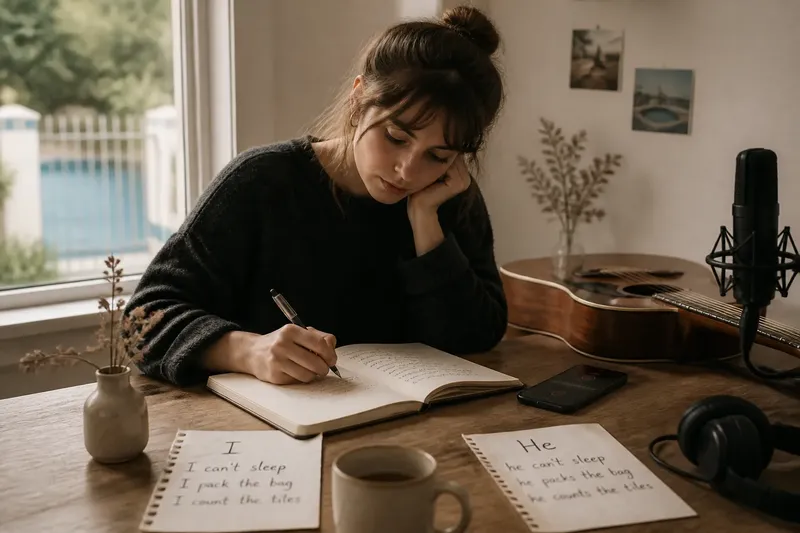
Imagine a songwriter has a scene about a brother waiting outside a closed swimming pool after an argument. In first person, “I count the blue tiles through the gate” makes the memory belong to the speaker; in third person, “he counts the blue tiles through the gate” leaves open whether the singer is a sibling, a witness or a storyteller. The expected observable difference is clear in the drafts: one foregrounds the speaker’s ownership, while the other makes the brother’s action the scene’s centre.
Let melody shape the choice
Point of view is a lyric decision, but it also has a sound. “I” is brief and often easy to place, whereas a character’s name may take more syllables and put stress in an awkward spot. That is not a reason to avoid names; it is a prompt to test the whole phrase against the tune. A line that reads elegantly can feel crowded when sung.
Pronoun placement can change emphasis. If a melody gives a long, exposed note to “I”, the singer may sound as though they are claiming the experience; if the held note falls on a character’s action, attention shifts towards what that person does. Try the line with a neutral vowel or a simple hum, then restore the words and notice whether their natural stresses sit comfortably in the phrase.
Arrangement can either reinforce or complicate the distance. A close, dry vocal may make a third-person account feel intimate, while a more distant vocal treatment may frame first-person words as recollection. These are expressive possibilities rather than fixed meanings: delivery, harmony and the surrounding sound can alter the impression.
Do not spend long searching for a supposedly perfect pronoun sound before the lyric’s scene is clear. A line that feels emotionally false will not be rescued by a convenient vowel, and a slightly less comfortable word may be worth keeping if it carries the song’s real point.
Track shifts and ambiguity
A viewpoint shift can mark a change in what the singer is willing to admit. A verse may describe “her” from outside, then a later line may reveal “I was there”; the movement can make recognition part of the song. It needs a cue, though, such as a change of tense, a newly named relationship or a clear turn in the scene. Without one, listeners may hear a continuity error rather than a reveal.
Second person, using “you”, complicates the choice because it can address another character, the listener or the singer’s past self. If a draft relies on “you”, ask who could answer that line. If the answer changes from one section to another, decide whether that instability is expressive or merely confusing.
Not every lyric needs to identify its speaker fully. Ambiguity can suit a song when the emotional situation remains understandable, even if the listener cannot say exactly who is narrating. The effort is not worthwhile when it leads to explanatory lines that spell out every relationship; retain only the clues needed to follow the scene.
Which viewpoint fits this song?
When does first person feel more intimate?
It tends to feel closer when the lyric gives the speaker specific knowledge, a present-tense choice or a thought they would not casually share. The intimacy comes from what the voice risks revealing, not from using “I” repeatedly.
Can a third-person lyric still feel personal?
Yes. A singer can describe a character with precise, affectionate attention, and a listener may sense a strong bond without being told what it is. Distinctive actions and selective detail usually do more than an explicit label such as “my friend”.
Should a songwriter name the character?
Use a name when it helps the listener distinguish people or keeps the scene grounded. Leave it out when the name adds syllables without clarifying the story, or when withholding it is part of the lyric’s intended distance.
How can a viewpoint change make sense?
Give the change a dramatic reason and a signal the listener can hear, such as a shift from past observation to present admission. Then check the surrounding lines so the new pronoun has a clear subject and does not accidentally alter who knows what.
Choose the voice that can sing
For a final decision, write a one-sentence description of the lyric’s listener-facing promise: “I am telling you what I did”, “I am showing you what she did”, or “I am trying to understand what happened to us”. Put each candidate beside the melody and sing the lines at a natural pace. The version that makes the promise clear while leaving room for the song’s feeling is usually the stronger draft.
First person or third person lyrics are not competing levels of emotional truth. They are different ways of placing the listener beside a song’s subject: inside the speaker’s account, close to another person’s actions, or moving between those positions with purpose. Keep the choice that gives the song both a believable voice and a scene worth hearing.